
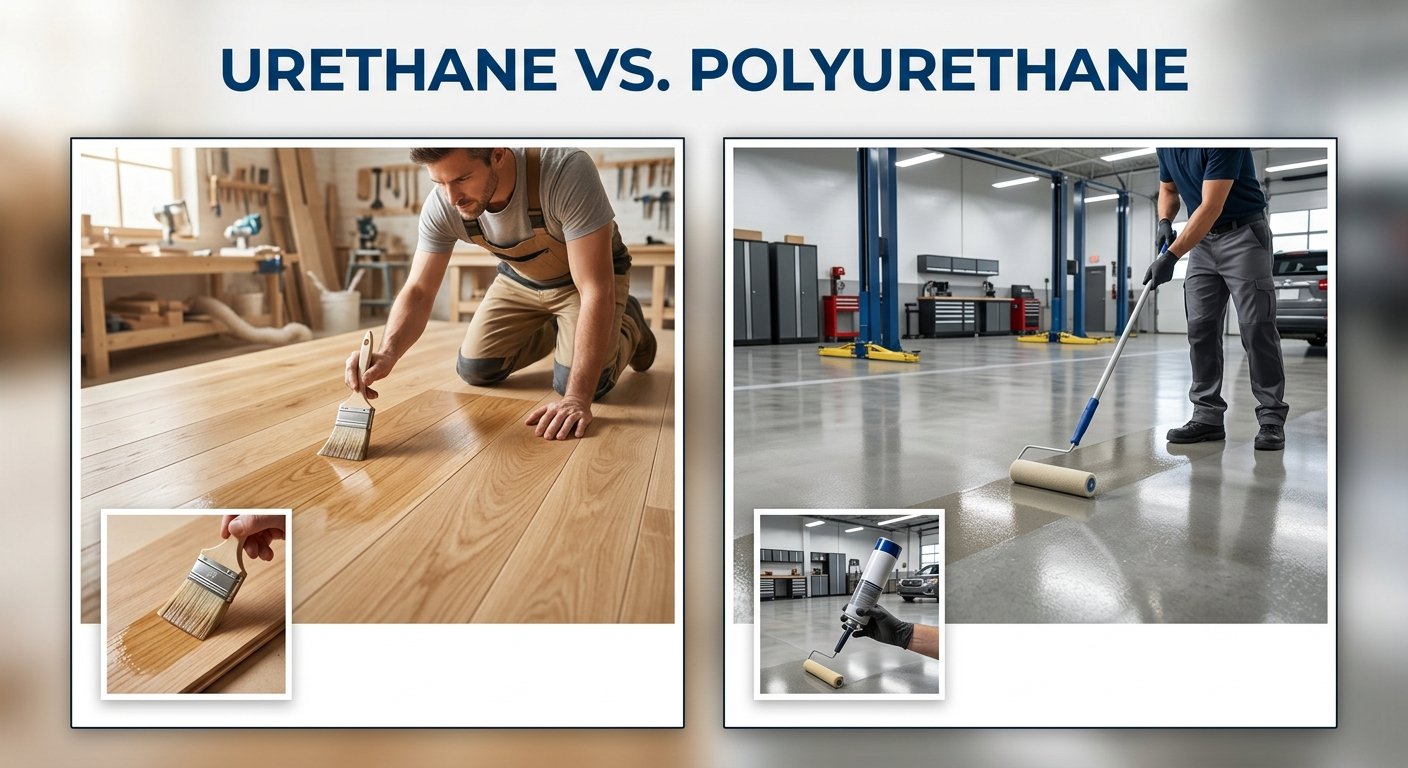
Urethane vs. Polyurethane: What's the Difference for Flooring?
Urethane vs. polyurethane is often a comparison between two names for the same family of materials, not two entirely different floor coatings. In chemistry, a urethane is a carbamate linkage, while polyurethane is a polymer containing multiple urethane linkages. In flooring products, manufacturers frequently use the terms interchangeably.
That distinction matters because choosing a floor finish based on the words printed on its container can be misleading. A product labeled urethane is not automatically softer, cheaper, or less durable than one labeled polyurethane. Its performance depends on the resin formulation, curing system, film thickness, surface preparation, and the conditions the floor encounters.
For hardwood floors, those conditions include foot traffic, furniture scratches, cleaning, and appearance. For concrete garages, moisture, tire heat, oil stains, and coating adhesion become more important. Commercial floors also require attention to chemical exposure, abrasion, slip resistance, and downtime.
This guide explains the difference between urethane and polyurethane, compares real coating systems, and shows how to choose a finish using technical specifications rather than marketing claims.
Is Urethane the Same as Polyurethane?
Yes, in everyday flooring terminology, urethane and polyurethane often refer to the same general class of coating materials. Chemically, however, they are not identical terms. Understanding the distinction prevents the mistake of assuming differently labeled products must have fundamentally different performance characteristics.
What Is Urethane?
Urethane is the traditional name for a chemical structure known as a carbamate linkage. These linkages appear within polyurethane polymers. In manufacturing and coating terminology, urethane is frequently shorthand for polyurethane.
Products described as urethane floor finishes, urethane sealants, or urethane coatings may therefore contain polyurethane chemistry. The name alone does not identify the complete formulation. An oil-modified urethane wood finish, for example, may use a urethane-modified alkyd resin. That should not be assumed equivalent to a two-component polyurethane floor coating.
The practical distinction: Urethane on a product label does not establish hardness, chemical resistance, lifespan, or suitability for a particular floor.
What Is Polyurethane?
Polyurethane is a broad family of polymers containing multiple urethane linkages. Polyurethane chemistry can produce rigid plastics, flexible foams, adhesives, sealants, elastomers, and protective coatings. Their properties differ considerably because their formulations and molecular structures differ.
In floor coatings, polyurethane can be formulated for abrasion resistance, flexibility, selected chemical resistance, appearance retention, and adhesion to appropriately prepared substrates. No single formulation maximizes every property.
Why Are the Names Used Interchangeably?
Urethane has become conventional shorthand in industry. Manufacturers use terms such as urethane finish, polyurethane topcoat, oil-modified urethane, and water-based urethane for related—but sometimes significantly different—formulations. In practical buying terms, do vendors use urethane and polyurethane to mean the same thing? Often, yes—but the technical data sheet must establish which coating system they are selling.
Expert selection principle: Never substitute the words urethane or polyurethane for a complete coating specification. Identify chemistry, intended substrate, preparation, and documented performance requirements.
Urethane vs. Polyurethane: Key Differences at a Glance
A meaningful polyurethane versus urethane comparison separates terminology from actual product performance.
|
Comparison factor |
Urethane |
Polyurethane |
|
Chemical meaning |
Carbamate linkage or commercial shorthand |
Polymer with multiple urethane linkages |
|
Flooring usage |
Common on coating and finish labels |
Identifies a broad polymer family |
|
Performance grade |
Not a standardized grade |
Wide range of formulations |
|
Hardness |
Cannot be determined by name |
Formulation-dependent |
|
Scratch resistance |
Product-specific |
Product-specific |
|
Water resistance |
Product-specific |
Product-specific |
|
UV stability |
Depends on chemistry |
Depends on chemistry |
|
Application and cure |
Varies by product |
Varies by product |
|
Cost and lifespan |
Cannot be determined by name |
Cannot be determined by name |
Bottom line: There is no scientific basis for claiming urethane is universally harder, more flexible, cheaper, or longer-lasting than polyurethane. Compare specific finishes rather than marketing labels.
Types of Urethane and Polyurethane Floor Coatings
Oil-Modified Urethane Finishes
Oil-modified urethane is commonly used on residential hardwood floors, particularly where a warm amber-toned finish is desired. Many products use oil-modified or urethane-modified alkyd chemistry and cure through oxidative reactions.
Advantages: A warm appearance; familiar application methods; often one-component with no separate hardener; potentially economical for appropriate residential uses.
Limitations: Gradual ambering; potentially longer drying and curing; stronger odors in many solventborne products; formulation-specific wear and chemical resistance.
A lightly used bedroom, study, or older wood floor may be an appropriate application. Simpler products should not be dismissed solely because they are less expensive.
Water-Based Polyurethane Finishes
Water-based polyurethane uses water as a major component of the liquid carrier. These products are widely used on hardwood when customers prefer a lighter appearance and less intense solvent odor.
The National Wood Flooring Association describes water-based finishes as generally clear, durable, and quick-drying. Actual properties vary by product.
Advantages: Often clearer appearance; commonly shorter recoating intervals; one- and two-component options; many lower-VOC choices; residential and commercial formulations.
Limitations: Application technique affects appearance; waterborne does not mean solvent-free or hazard-free; full cure may take longer than surface drying; premium systems can demand careful mixing and processing.
The claim that water-based polyurethane is always weaker than solvent-based material is not reliable. Compare tested product performance.
One-Component vs. Two-Component Polyurethane
One-component (1K) coatings are typically supplied ready to use, apart from manufacturer-required stirring. Depending on the chemistry, they may cure by oxidation, moisture reaction, or another process.
Two-component (2K) coatings use a resin and compatible hardener mixed before application. Correct ratios, thorough mixing, limited pot life, and controlled application conditions are essential.
|
Feature |
One-component |
Two-component |
|
Mixing |
Usually no separate hardener |
Required resin/hardener mixing |
|
Pot life |
Usually no post-mixing restriction |
Limited working time |
|
Application |
Often simpler |
Greater process control |
|
Performance |
Wide range |
Can provide demanding service performance |
|
Typical uses |
Residential and selected commercial |
Demanding residential, commercial, industrial |
|
Principal risk |
Incorrect application or cure |
Mixing, ratio, pot life, and cure errors |
A two-component product is not automatically necessary for a lightly used residential floor. It can be justified when a project requires documented wear or chemical resistance.
Aromatic vs. Aliphatic Polyurethane
Aromatic polyurethane coatings can yellow or change appearance under UV exposure. Aliphatic polyurethane systems are generally favored where exterior color and gloss retention are priorities.
This is not a blanket recommendation: an exterior coating also needs appropriate substrate compatibility, moisture tolerance, wear resistance, and an approved overall system.
How Do Urethane and Polyurethane Floor Coatings Compare in Performance?
Scratch and Abrasion Resistance
Scratching and abrasion are related but different. A finish may withstand gradual foot-traffic wear while still showing marks from grit or furniture. Hardness alone does not reliably predict actual wear life: adhesion, flexibility, film thickness, and type of contact all matter.
ASTM D4060 describes a Taber Abraser method for evaluating organic coating abrasion. Results must be compared under matching test conditions, including wheel, load, cycles, and measurement method. An isolated abrasion number without those details is a poor basis for purchase.
Water and Moisture Resistance
Resisting a spill does not make an entire floor waterproof. Hardwood remains vulnerable to sustained water and humidity changes. Concrete may allow moisture vapor movement that compromises adhesion even when a coating itself resists water from above.
For concrete, follow the specified slab moisture assessment and the chosen system's limits.
Chemical and Stain Resistance
Chemical resistance is especially important in garages and commercial facilities, but the term polyurethane is no guarantee against gasoline, solvents, disinfectants, acids, or alkalis. Check the formulation, chemical concentration, temperature, contact duration, and cleaning procedures against manufacturer test data.
Yellowing and UV Resistance
Traditional oil-modified finishes can develop warmer amber color with age. Aromatic polyurethane coatings may change appearance in sunlight. Aliphatic formulations are often selected when UV color retention is important. Color change does not always mean protective properties have failed, but it may make the finish unacceptable aesthetically.
Drying Time vs. Full Cure Time
A floor may be touch-dry long before its final properties develop. Review product-specific timelines for recoating, light foot traffic, furniture, vehicles, cleaning chemicals, and heavy service. Temperature, humidity, ventilation, and film thickness can all change the cure schedule.
Which Floor Coating Is Best for Your Application?
|
Application |
Main priorities |
What to check |
|
Residential hardwood |
Appearance, household wear, maintenance |
Color, cleaning, recoating |
|
High-traffic hardwood |
Abrasion, cleaning, appearance |
Tested finishes, including suitable 2K systems |
|
Garage concrete |
Adhesion, tires, stains, moisture |
Slab testing, surface profile, complete system |
|
Commercial flooring |
Traffic, cleaning, downtime, slip resistance |
Tests for expected service conditions |
|
Industrial floors |
Chemicals, loads, temperature |
Project-specific industrial specifications |
Hardwood Floors: Appearance and Maintenance
For hardwood, start with how the room will be used. A low-traffic bedroom can be a good place for a suitable oil-modified finish when ease of use and an amber look matter. Busy corridors or demanding commercial wood floors may benefit from premium waterborne or two-component systems with the needed test results.
A pale wood floor intended to stay light needs special attention to ambering. No coating removes the need for proper cleaning or maintenance.
Concrete Garage Floors: Adhesion Comes First
Garage coatings frequently fail because preparation and substrate moisture were not adequately addressed. Before specifying a finish, assess concrete moisture, remove contaminants and unsuitable existing coatings, create the specified surface profile, and verify the whole system is appropriate for hot-tire and vehicle exposures.
Diamond grinding or shot blasting may be appropriate; follow the manufacturer's surface-preparation specification. Some systems combine compatible epoxy layers and polyurethane topcoats. Evaluate the entire system rather than its final layer in isolation.
Commercial and Industrial Floors: Specify the Exposure
Restaurant kitchens, warehouses, hospitals, and manufacturing plants do not have identical flooring demands. Consider cleaning chemicals, concentrations, rolling loads, impact, traffic, temperatures, slip resistance, and reopening time.
Under extreme chemical or thermal conditions, another flooring chemistry—such as an appropriate epoxy, vinyl ester, or specialty system—may perform better than polyurethane. Define the operating environment first.
Why Urethane and Polyurethane Floor Coatings Fail
The following are documented categories of failure, not invented firsthand project stories.
Inadequate Surface Preparation
Contamination, dust, laitance, wax, or an unsuitable surface profile can obstruct bonding. Prepare hardwood and concrete according to the specified method; do not assume a premium coating can compensate for poor preparation.
Moisture-Related Delamination
Excess slab moisture can contribute to blistering or debonding. ASTM F2170 describes in-situ relative-humidity testing of concrete. Results must be interpreted against the selected system's limits, and a single test location may not represent the whole floor.
Incorrect Mixing or Cure Conditions
Two-component products require correct proportions, thorough mixing, and application within pot life. Cold temperatures, humidity, and excessive coating thickness can also interfere with curing. Follow the technical data sheet rather than relying on generic curing times.
Yellowing and Discoloration
UV, oxidation, resin chemistry, and environmental factors can change color. Select finishes using long-term appearance requirements, particularly on pale hardwood and sunlit concrete.
Incompatible Existing Coatings
A new waterborne or solventborne finish should not be applied blindly over an unknown existing layer. Identify the previous finish, confirm it is sound and cured, clean and abrade as required, and follow manufacturer compatibility and adhesion-test guidance.
Urethane vs. Polyurethane Cost: Why Price per Gallon Misleads
The least expensive can is not necessarily the least expensive installed floor. The actual comparison includes material, primer, coverage, number of coats, labor, preparation, waste, downtime, and future maintenance.
Solids Content and Film Thickness
Volume solids help estimate the protective material remaining after volatile components depart. Dry film thickness (DFT) measures the resulting film; wet film thickness (WFT) measures it at application. A simplified theoretical relationship is:
DFT = WFT × Volume Solids Fraction
For example, 100 micrometers of WFT with 50% volume solids theoretically yields 50 micrometers of DFT, assuming uniform film and no losses. Always follow manufacturer recommendations; excessive film build can introduce curing or appearance defects.
Illustrative Cost Comparison
The following numbers are hypothetical, not actual supplier quotations, and assume both systems are approved for the same project.
|
Factor |
Coating A |
Coating B |
|
Price per gallon |
$60 |
$90 |
|
Coverage per coat |
300 sq. ft./gal |
400 sq. ft./gal |
|
Number of coats |
3 |
2 |
|
Gallons for 1,000 sq. ft. |
10 |
5 |
|
Theoretical material cost |
$600 |
$450 |
The second system costs more per gallon but less for its theoretical coating material. The example excludes primer, tax, labor, preparation, and waste; neither coating can be selected based on these prices alone.
Urethane vs. Polyurethane Adhesive: Is There a Difference?
The phrase urethane vs polyurethane adhesive raises the same naming issue. Urethane adhesives are commonly polyurethane-based. One is not automatically a separate or better adhesive class simply because of its label.
For flooring adhesives, evaluate approved substrates, flooring material, subfloor moisture limits, elasticity and expected movement, working time, and cure conditions. Some polyurethane adhesives are moisture-curing, but that does not mean they can withstand unlimited moisture from concrete.
Adhesive versus coating: A polyurethane adhesive bonds materials together; a polyurethane floor finish creates a protective surface film. They serve different functions and cannot be substituted for each other.
How to Choose the Right Floor Coating: A Three-Part Checklist
1. Identify the Chemistry and System
Confirm whether the product is oil-modified, waterborne, solventborne, one-component, or two-component; how it cures; and whether it is approved for the exact substrate and UV conditions.
2. Verify Film Build and Test Results
Check recommended wet and dry film thickness, volume solids, coverage, number of coats, abrasion methods, and chemical-resistance data. Do not compare results produced under incompatible test conditions.
3. Confirm Preparation and Cure Requirements
Check substrate moisture limits, cleaning, surface profile, application temperatures, humidity, mixing ratios, pot life, recoating, and reopening times for foot traffic, furniture, vehicles, or chemical exposure.
These three checks generally reveal more about suitability than the product name or advertised number of years of service.
Common Myths About Urethane and Polyurethane
Myth: Urethane Is Always Softer Than Polyurethane
False. The terminology does not define standardized hardness grades. Assess product-specific properties.
Myth: Polyurethane Is Always More Durable
False. A product sold as urethane may itself be polyurethane-based. Compare defined formulations under relevant conditions.
Myth: Water-Based Polyurethane Is Always Weaker
False. Modern waterborne systems span many performance levels. Assess test results, not just the carrier medium.
Myth: Harder Always Means Longer-Lasting
False. Scratch, abrasion, adhesion, flexibility, and impact are distinct performance considerations.
Myth: An Expensive Coating Will Always Last Longer
False. Moisture, poor preparation, incompatible layers, and curing mistakes can compromise expensive coatings.
Myth: Polyurethane Makes Every Floor Waterproof
False. A protective film can resist spills without waterproofing substrate joints, edges, cracks, or the whole flooring assembly.
Frequently Asked Questions
Is Urethane and Polyurethane the Same Thing?
In ordinary coatings terminology, the terms often refer to the same broad material family. Chemically, urethane is a linkage and polyurethane is a polymer family. Different products may still use significantly different formulas.
What Is the Main Difference Between Urethane and Polyurethane?
The difference between urethane and polyurethane is primarily terminology and chemical specificity, not an automatic difference in strength or quality. Check individual coatings rather than compare labels.
Is Urethane Stronger Than Polyurethane?
Neither name alone establishes strength. Hardness, flexibility, wear, and chemical resistance depend on the specific formulation and test conditions.
Is Urethane or Polyurethane Better for Hardwood Floors?
A suitable oil-modified finish can offer a desired amber tone and easier application; waterborne and two-component finishes can meet different appearance and performance objectives. The better choice depends on the room and verified product data.
Does Polyurethane Scratch Easily?
Scratch behavior varies by finish and conditions. Grit, furniture, footwear, cleaning, and coating properties all matter. No standard floor finish is entirely scratch-proof.
Can Polyurethane Be Used on Concrete Garage Floors?
Yes, when the product and complete system are approved for concrete and the expected moisture, vehicle, and hot-tire conditions. Surface preparation is essential.
Does Urethane Turn Yellow Over Time?
Some finishes do. Oil-modified wood finishes often amber with age; aromatic systems may discolor with UV exposure. Aliphatic chemistry is often selected for better exterior color retention.
Is Water-Based Polyurethane Better Than Oil-Based Polyurethane?
Not always. Waterborne products often dry faster and look clearer; oil-modified products may provide a warmer appearance. Compare installation, durability, color, and maintenance for the actual products.
How Long Does a Polyurethane Floor Coating Last?
There is no universal lifespan. Service life depends on formulation, substrate, preparation, thickness, traffic, environment, and maintenance. Seek project-relevant performance evidence and warranty details.
Can Water-Based Polyurethane Go Over an Oil-Based Finish?
Sometimes, with proper cure, cleaning, abrasion, and product compatibility. Follow manufacturer instructions and use an adhesion test when needed.
Is Fully Cured Polyurethane Safe?
Suitability depends on the specific formulation and intended use. Uncured coatings can contain solvents or reactive components requiring protective measures. Follow the safety data sheet, ventilation precautions, and re-entry guidance.
Should I use urethane or polyurethane?
Choose a coating formulation, not a label. For wood floors, compare appearance, wear performance and recoating needs; for concrete, verify substrate moisture, adhesion requirements and service conditions. A product called urethane may itself be polyurethane-based.
Should I use spar urethane or polyurethane?
Spar urethane is generally marketed for exterior wood exposed to weather and movement, while polyurethane is a broad coating family with both interior and exterior formulations. For an indoor floor, use a finish specifically approved for flooring; do not assume a spar product is suitable for foot traffic.
What is another name for urethane?
In coating marketing, urethane is often shorthand for polyurethane. In chemical terminology, a urethane linkage is also called a carbamate linkage. The word alone does not identify the full coating formulation.
Is urethane a plastic?
Polyurethanes are a broad family of polymeric materials that can be formulated as plastics, elastomers, foams, adhesives or coatings. Urethane itself refers to a chemical linkage in this context, not one specific type of plastic.
Are urethane and polyurethane interchangeable?
The names are frequently used interchangeably in product marketing, but different coatings are not necessarily interchangeable in use. Confirm compatibility, substrate, coating chemistry and curing requirements before substituting products.
Final Verdict
The urethane vs polyurethane debate is simpler once the naming is understood: they are not two standardized competing grades of floor protection. What matters is how the actual coating is formulated and whether it is appropriate for the floor and its operating conditions.
For hardwood, prioritize appearance, wear, cleaning, and recoating. For garages, prioritize concrete moisture, surface preparation, adhesion, and tire exposure. For commercial and industrial floors, require documented evidence for chemicals, loads, temperatures, and downtime.
The best floor coating is not the one with the more impressive name. It is the system that meets the flooring requirements and can be installed correctly at the site.
Technical References
- National Wood Flooring Association — Wood Floor Finishes: https://woodfloors.org/finishes/
- National Wood Flooring Association — Maintenance: https://woodfloors.org/maintenance/
- ASTM D4060 — Abrasion Resistance of Organic Coatings: https://store.astm.org/standards/d4060
- ASTM F2170 — Relative Humidity in Concrete Slabs: https://store.astm.org/standards/f2170
- U.S. EPA — Toluene Diisocyanate and Related Compounds: https://www.epa.gov/assessing-and-managing-chemicals-under-tsca/fact-sheet-toluene-diisocyanate-tdi-and-related