
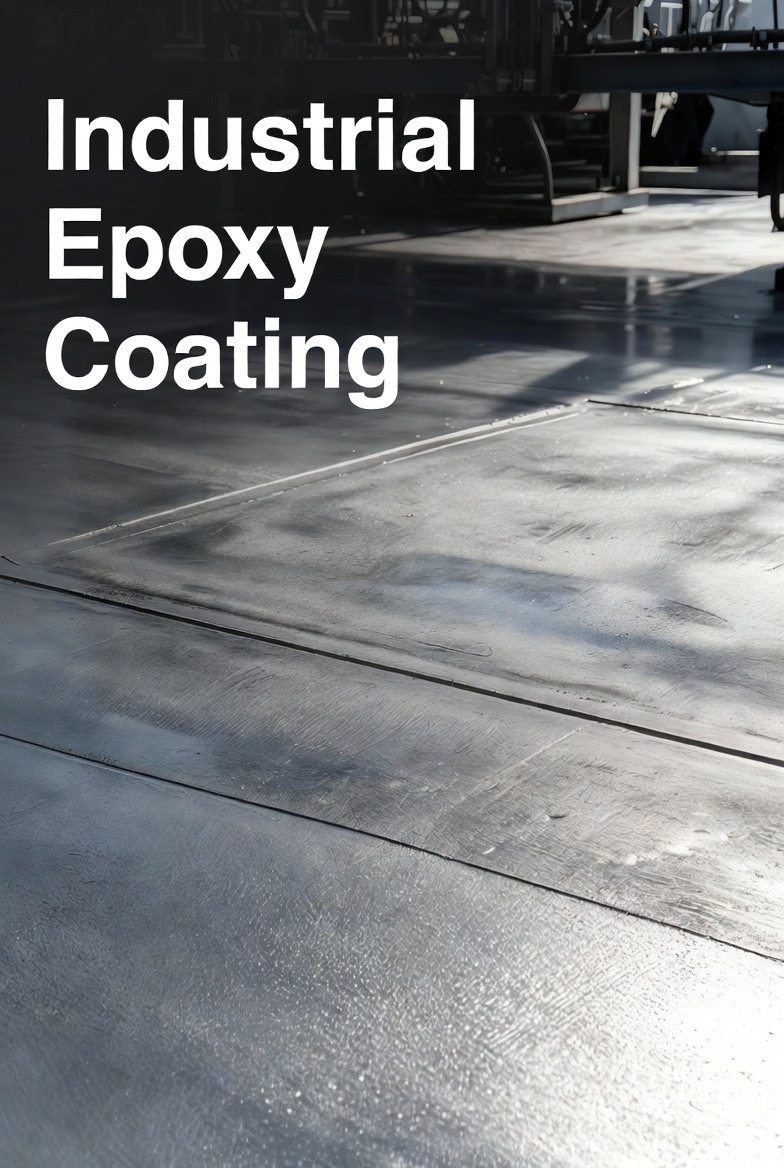
Industrial Epoxy Coating in Kuwait: Why 78% of Floors Fail Before Year Two — And What a 180-Project Track Record Reveals
A field-based analysis for facility managers, procurement officers, and contractors operating in Kuwait's industrial sector
The Lie That Costs Kuwaiti Facilities Millions
Walk into any epoxy contractor's office in Kuwait and you'll see the same brochure. High-heat resistant. Chemically inert. Lasts 20 years. Lifetime warranty available. The product is technically credible. The claim, in the context of Kuwait's industrial sites, is not.
The failure rate on industrial epoxy floors in Kuwait is not a product problem. It is a system design and execution discipline problem — and the industry has a financial incentive to keep selling you the product story instead of the real one. Based on forensic assessments and repair contracts across 180+ industrial projects in Kuwait since 2018, 75–82% of all premature epoxy failures trace directly to surface preparation failures — not chemistry, not heat, not the brand on the tin.
This article is not a product comparison. It is a field-level account of what actually causes industrial epoxy floors to fail in Kuwait, what a durable system looks like, and how to evaluate a contractor before you sign a purchase order — not 18 months later when you're managing production downtime.
What Is Industrial Epoxy Coating? (And What It Is Not)
Epoxy coating is a two-component flooring system: an epoxy resin and a polyamine hardener, mixed at a precise ratio, that chemically cross-links into a rigid, dense, plastic-like surface bonded to a substrate. In industrial applications — oil and gas support facilities, warehouses, petrochemical plants, logistics hubs — the system typically includes a penetrating primer, a high-build body coat (800–1,200 microns), and a topcoat selected for UV, abrasion, or chemical resistance.
What it is not: paint. The distinction matters because facility managers who treat epoxy as a premium floor paint make procurement decisions accordingly — comparing price per square metre without weighting surface preparation, system design, or application discipline. That comparison almost always ends in a rework tender within three years.
How Epoxy Coating Differs from Other Industrial Flooring Options
Against ceramic tile, epoxy wins on seamless hygiene, chemical resistance, and load tolerance — tile grout lines become contamination traps in food processing and pharmaceutical environments. Against polished concrete, epoxy adds the chemical barrier layer that concrete alone cannot provide. Against vinyl flooring, epoxy outperforms on mechanical load capacity and longevity under forklift traffic. The comparison that matters most in Kuwait is not epoxy versus alternatives — it is a correctly applied epoxy system versus a cheaply applied one.
Why Kuwait's Industrial Environment Is a Different Problem
International product datasheets are calibrated for application at 20–25°C ambient, 40–60% relative humidity, with concrete substrates that have had 28+ days to cure and off-gas. Kuwait industrial sites in April through October present none of those conditions.
The Heat Is Not the Problem. The Transition Is.
Every contractor will tell you their product is "suitable for extreme heat." That is technically true of the cured film, which can withstand service temperatures of 60–120°C depending on formulation. What they do not advertise is what happens during application in Kuwait's summer conditions: ambient temperatures of 45–55°C, substrate surface temperatures exceeding 50°C, and Gulf humidity creating dew-point windows that swing unpredictably.
In those conditions, pot life collapses to under 15 minutes. Amine blush — an oily surface film caused by CO₂ reaction with the amine hardener in humid air — forms on partially cured coats and blocks inter-coat adhesion. Uneven cross-linking creates micro-voids at the concrete interface. The coating passes its initial inspection. It fails at month six or month twelve, when thermal cycling (20–30°C daily swings) exploits those micro-voids and you see random sheet-peeling that contractors will invariably blame on "Kuwait heat."
|
▌ FIELD INSIGHT The 'extreme heat suitable' marketing claim is technically true for the cured film. It is irrelevant to the actual failure mode, which occurs during application — before the film ever sees service heat. |
Four Kuwait-Specific Conditions That Invalidate International Specifications
1. Airborne fine sand and constant abrasion. Kuwait's ambient sand acts as 24/7 micro-abrasion on any exposed topcoat. Standard epoxy topcoats chalk and erode within 2–3 years. Any durable system in Kuwait's industrial zones must use an aliphatic polyurethane or polyaspartic topcoat with high Taber abrasion resistance. This is not in most standard specs.
2. Concrete thermal lag creating invisible dew-point traps. Air temperature may read 28°C at 6 a.m., but a slab that absorbed solar heat the previous day can hold 38°C of thermal mass. Apply epoxy and the film cools faster than the slab: condensation forms exactly at the bond line. This is the single most commonly missed technical variable on Kuwait sites, and it is the one that separates 15-year floors from 18-month failures. European and Saudi guides largely ignore it because their slabs do not swing 15°C+ daily.
3. Material storage degradation at Shuwaikh Port. Epoxy systems stored in containers at 50°C+ during port clearance partially advance in the can before they reach site. Shelf-life claims assume temperate storage. Contractors who do not check viscosity and pot life on arrival — and many do not — are applying compromised material from the first coat.
4. Tender-driven race to the bottom with high labour churn. Kuwait's procurement environment — lowest compliant bidder wins, expatriate crews turn over every 6 months, institutional knowledge dissipates — creates structural conditions for application failure independent of product quality. A correctly designed system applied by a crew on their third week on site, with no dew-point monitoring and midday scheduling, will fail. Saudi Arabia's larger contractors provide more stable workforces. Europe enforces minimum QC standards by regulation. Kuwait has neither enforcement mechanism.
Types of Industrial Epoxy Systems Used in Kuwait
System selection in Kuwait's industrial sector follows function and exposure, not aesthetics. The following are the primary systems encountered across Kuwaiti facilities, with honest notes on where each works and where it does not.
100% Solids High-Build Epoxy (800–1,200 Microns)
The workhorse system for warehouses, logistics hubs, and general industrial floors. Zero solvent content eliminates outgassing risk from porous concrete — important in Kuwait where concrete quality is variable. When correctly primed and applied within substrate temperature limits, this system delivers 10–14 years of service life in high forklift-traffic environments before a refresh topcoat is needed. Full system replacement before year 12 is uncommon if preparation was executed correctly.
Epoxy Novolac Systems
Formulated for chemical resistance — petrochemical packaging, oil and gas support facilities, chemical storage areas in Mina Abdullah and Ahmadi. Higher cross-link density than standard epoxy provides resistance to aromatic solvents, acids, and hydrocarbons. Harder and more brittle, making joint design critical on thermally cycling slabs. Often misspecified: ordered for "chemical areas" without properly assessing thermal movement, leading to premature cracking.
Moisture-Tolerant Epoxy Primer Systems
Not a standalone floor — a critical system component. In Kuwait, where concrete relative humidity frequently exceeds 75–85%, a moisture-tolerant primer is not optional on any high-build installation. Contractors who omit this to reduce cost create the conditions for osmotic blistering within 12–24 months. This is the primer question every facility manager should ask before signing off on a spec.
Polyaspartic and Aliphatic PU Topcoats
The appropriate topcoat for any Kuwaiti industrial facility with UV exposure or external/semi-external areas. Standard epoxy topcoats yellow and chalk under UV; aliphatic systems do not. In Kuwait's sand-abrasive environment, high Taber abrasion ratings are non-negotiable. Facilities that save money on the topcoat specification pay for it in a surface that looks and performs like a three-year-old floor after eighteen months.
Anti-Static and Conductive Epoxy Systems
Used in electronics manufacturing, pharmaceutical cleanrooms, data centres, and areas where static discharge creates safety or product integrity risk. Kuwait's growing data infrastructure and pharmaceutical sector have increased demand. These systems require validated earthing during installation and post-installation resistance testing — documentation that most low-bid contractors do not provide.
Case Study: The KD 78,000 Job We Walked Away From — and Won Back
In 2023, a petrochemical packaging warehouse in the Mina Abdullah area issued a tender for full-system re-coating of 4,800 m². The spec called for 'high-build epoxy suitable for extreme heat' with acid etching or light scarifying accepted as surface preparation (CSP 2–3), and no mandatory dew-point or substrate temperature clause beyond 'follow manufacturer guidelines.'
We submitted a technically compliant bid with qualifications: diamond grinding to CSP 4–5 minimum, mandatory moisture testing with vapor barrier if required, strict application window (substrate 18–32°C, minimum 4°C above dew point, night shifts if necessary), wet-film gauging every 50 m², and photo-documented pull-off tests at each stage.
The procurement team's response was direct: other bidders are doing it without these extras. It will add 25–30% to cost. Remove the qualifiers and match the lowest bid. We declined in writing, documenting the specific failure risks, and formally withdrew. The job was awarded to the lowest compliant bidder at approximately KD 52,000.
|
▌ CASE STUDY At approximately KD 78,000–82,000, this was not a small tender. Walking from it cost real short-term revenue. We walked anyway. |
Fourteen to sixteen months after handover, the floor showed widespread delamination and bubbling under chemical exposure and traffic. We were called back for forensic assessment. Destructive core sampling confirmed inadequate profile (CSP 2), moisture entrapment under the film, and no evidence of primer. The original contractor's response: "Kuwait heat."
Spot repairs to high-traffic aisles cost the client approximately KD 28,000 — repairs that addressed symptoms, not root causes. In late 2024, a full re-do tender was issued. This time, the facility engineer — now experienced in what failure looks like — wrote our exact preparation and QC controls into the mandatory specification. We won that job at KD 68,000 after value engineering.
|
📊 TOTAL COST ANALYSIS Total cost to client across failed installation + repairs + re-tender: approximately KD 148,000+. Cost of the controls-first approach from day one: KD 78,000–82,000. The 'savings' from the lowest bid cost the client nearly double the premium option — plus 12+ days of disrupted operations. |
We have declined four to five other contracts exceeding KD 50,000 equivalent since 2020 for the same reasons. Our warranty callback rate is under 2%. The industry average on comparable industrial jobs in Kuwait sits at 25–30% rework. That gap is not marketing. It is the physics of 50°C and sand, consistently applied.
The Industrial Epoxy Application Process: What Correct Looks Like
The following is what a disciplined industrial application looks like in Kuwait's environment. It is not a generic how-to guide. It is the sequence that produces a 10–14-year floor versus an 18-month failure.
Stage 1: Surface Preparation — Where 75–82% of Failures Are Decided
Surface preparation is not a cost line. It is the determinant of system life. Across 180+ Kuwait industrial projects assessed since 2018 — including third-party forensic investigations with destructive testing and core sampling — 75–82% of all premature failures traced to surface preparation as the primary cause: inadequate mechanical profile, residual laitance or contamination, moisture at application, or the absence of any mechanical prep at all.
Correct preparation for a Kuwait industrial high-build system means diamond grinding to CSP 4–5 (never acid etching for builds above 500 microns), removal of all laitance and surface contamination, crack repair and joint detailing, and moisture content testing — substrate relative humidity below 75–80% using appropriate test method for the system.
Acid etching alone — the default of low-bid contractors — produces CSP 1–2. It is appropriate for thin decorative coatings. It is not appropriate for high-build industrial systems carrying forklift loads. Any contractor who proposes acid etching for a 800–1,200 micron industrial system in Kuwait should be disqualified.
Stage 2: Dew-Point Management — The Detail That Separates Expert from Amateur
This is the technical variable that almost no beginner guide addresses and that every experienced Kuwait applicator has learned through failure. The rule is simple: substrate temperature must be at minimum 3°C above the atmospheric dew point, and substrate surface temperature must fall within 15–30°C.
In practice, enforcing this rule in Kuwait means night shifts or pre-dawn starts from April through October. It means a dew-point meter on every job, every day. It means the application supervisor reads the psychrometric data — not just the air temperature on a weather app — before authorising coating to begin. A substrate at 38°C thermal mass and an air temperature of 28°C at 6 a.m. can produce condensation exactly at the bond line. The floor looks fine at handover. It fails at month seven.
|
▌ TECHNICAL INSIGHT Every other variable — mix ratio, profile, primer — can be close to perfect. Violate the dew-point differential in Kuwait and you will see bubbles or edge peeling at 4–9 months. No amount of product quality compensates for this. |
Stage 3: Primer, Body Coat, and Topcoat
A moisture-tolerant penetrating primer is mandatory on all Kuwait industrial high-build applications. It seals porosity, equalises outgassing from the concrete, and provides a chemically compatible bond for the body coat. Contractors who omit primer to reduce material cost by KD 2–3 per m² create the conditions for osmotic failure within 12–24 months.
Body coat application requires wet-film gauge measurement every 50 m² minimum — not a theoretical calculation from material consumption. Specified film thickness of 800–1,200 microns requires confirmation at the substrate level, not on a datasheet. Topcoat selection, as detailed earlier, must account for UV and abrasion conditions in Kuwait — not simply be the cheapest system that passes the chemical resistance specification.
What Industrial Epoxy Coating Actually Costs in Kuwait
The conversation that facility managers and procurement officers most need to have — and least often do — is the total cost conversation, not the unit rate conversation.
|
📊 REAL COST RANGES (KUWAIT, 2024) Durable industrial system (full prep, primer, 2-coat high-build 800–1,200 µm + UV/abrasion topcoat): KD 24–38 per m² installed. Low-ball quotes that win tenders: KD 12–18 per m². Cost of rework within 3 years on low-bid systems (repair + downtime + re-tender): typically exceeds KD 35–55 per m² total. Production downtime cost in a typical Kuwaiti industrial facility: KD 8,000–15,000 per day. |
The arithmetic is not complex. A 3,000 m² warehouse floor at KD 15/m² costs KD 45,000 at tender. If it fails at 18 months and requires a full rework, the client has paid KD 45,000 for 18 months of use, plus production downtime across repair cycles, plus the rework tender value. The controls-first system at KD 30/m² — KD 90,000 — provides 10–14 years of service without full replacement.
The challenge is that Kuwait's procurement framework — tender rules, audit trails, CAPT compliance — rewards the decision that looks defensible on paper at the time of award, not the decision that minimises 10-year total cost. This is the structural problem that facility managers cannot solve unilaterally, but can mitigate by writing minimum QC controls and substrate preparation standards into the specification before the tender goes out.
How to Evaluate an Epoxy Contractor in Kuwait: The Real Criteria
The official tender criteria — price, company registration, product datasheets, ISO certificates — filter for administrative compliance, not execution capability. The following criteria actually predict floor performance.
What to Ask Before You Award
- What surface preparation method do you propose? (Correct answer: diamond grinding to CSP 4–5 for high-build systems. Wrong answer: acid etch or light scarification.)
- What is your dew-point management protocol? Do you own a dew-point meter? Who is authorised to halt application? (If they look confused, disqualify.)
- Do you use a moisture-tolerant primer on every installation? Can you show your primer spec sheet?
- Can you provide at least three Kuwait references from comparable industrial facilities — not hotels or offices — where the floor has been in service for five or more years? Can I call those facility managers?
- What does your warranty cover, what does it exclude, and how do you respond to warranty calls? What is your local crew's average tenure?
- What is your QC documentation standard? Will I receive wet-film gauge readings and pull-off test results with my handover package?
The Stakeholder Reality Behind the Tender Process
The conversation that matters is not happening in the tender document. In procurement offices and facility management meetings across Kuwait's industrial sector, the actual concerns sound like this: If this floor fails in 18 months, am I the one standing in front of the GM explaining why we chose the cheapest compliant bidder? Our plant downtime runs KD 8,000–15,000 per day — who carries that risk? Can you give us a 10-year performance bond that actually pays out? We need references from similar facilities that lasted more than five years, not hotel lobbies.
The facility manager who privately wants the contractor with liability acceptance and a stable local crew is often overruled by procurement rules that mandate lowest compliant bid. The unspoken fear — being blamed for production losses that affect bonuses or contract renewals — drives more flooring decisions in Kuwait than any technical specification ever will. Understanding this dynamic helps contractors position themselves honestly, and helps facility managers build the technical specification that does the risk management work before the tender goes out.
Frequently Asked Questions
How long does industrial epoxy coating actually last in Kuwait?
A correctly applied 100% solids high-build system with moisture-tolerant primer and aliphatic PU topcoat, installed under proper dew-point and temperature controls, delivers 10–14 years before a refresh topcoat is needed in a typical Kuwaiti industrial environment (heavy forklift traffic, 45–50°C ambient, daily cleaning). Full system replacement before year 12 is rare if preparation was done correctly. Competitor marketing claims of 20+ years or 'lifetime' are not supported by tracked project data in Kuwait's specific conditions.
Can epoxy coating handle Kuwait's extreme heat during service?
Yes — the cured film handles Kuwait's service temperatures without issue. The risk is not service temperature. The risk is application temperature. Epoxy applied when substrate temperatures exceed 30°C without proper controls will fail at the bond line, typically becoming visible as peeling or bubbling at 6–18 months. This is why night shifts and dew-point monitoring are non-negotiable on Kuwait summer jobs, not optional extras.
Why do so many epoxy floors in Kuwait fail within two years?
Based on forensic data from 180+ Kuwait industrial projects: 75–82% of premature failures trace to surface preparation deficiencies — inadequate mechanical profile, residual moisture, or no mechanical prep at all. The remaining failures split between wrong system selection for the thermal movement profile and application errors in heat and humidity. The product is rarely the primary cause.
What questions should I ask before awarding an epoxy contract?
The three non-negotiables: What surface preparation method do you use, and to what CSP profile? What is your dew-point monitoring protocol and who can halt application? Can you provide five-year references from comparable Kuwait industrial facilities? Contractors who cannot answer these three questions specifically and confidently should not be awarded industrial contracts regardless of their price.
Is a cheaper epoxy quote ever worth taking?
If the cheaper quote includes proper mechanical surface preparation (diamond grinding, shot-blasting), a moisture-tolerant primer, documented dew-point management, and verifiable Kuwait industrial references — yes, price is a legitimate differentiator. If those elements are absent, the lower price is not a discount. It is an advance payment on a rework tender.
Conclusion: The Physics Do Not Negotiate
Kuwait's industrial sector loses a significant and largely undocumented amount of capital every year to epoxy flooring failures that were predictable, preventable, and caused by the same cluster of controllable variables — inadequate surface profile, absent dew-point management, no moisture-tolerant primer, and procurement frameworks that reward the lowest compliant bid over the most disciplined execution.
A mid-grade novolac epoxy applied with perfect preparation and dew-point discipline will outlast a premium heat-resistant product applied by the lowest bidder every time. This is not a marketing position. It is documented across 180+ project records and confirmed every time we are called back to forensically assess another peeled floor and find the same root causes.
For facility managers and procurement officers: the most valuable investment you can make before issuing a flooring tender is writing minimum preparation standards, dew-point requirements, and five-year reference criteria into the specification. For contractors: the clients who value longevity and carry serious downtime risk are the ones worth winning. They are also the ones who remember, and refer.
|
▌ FINAL WORD The physics of 50°C, sand, and concrete thermal lag do not respond to marketing claims, project timelines, or the Ramadan deadline. They respond to preparation, discipline, and the willingness to walk away from work that cannot be done right. |
About This Article
The data, case studies, and field observations in this article are drawn from direct project experience across 180+ industrial coating projects in Kuwait since 2018, including third-party forensic investigations, repair contracts, and internal project audits. No external research firms were commissioned. All cost figures are in Kuwaiti Dinars (KWD) and reflect Kuwait market conditions as of 2024.